Lars Brownworth answers your questions from the 12 Byzantine Rulers, Lost to the West and Norman Centuries projects.

Did the Byzantine Empire Fall in 1991?

Jan 31 2012

Drew asks if we can consider the Soviet Empire as a continuation of Byzantium.  It’s well known that Moscow at one time considered itself as the ‘third Rome’ (or second Constantinople).  There were some compelling reasons to think this.  Moscow was originally built on seven hills like Rome and Constantinople, Russian troops had been serving in the Byzantine army since the 10th century, and the Russian alphabet, Orthodoxy, and (to some degree) culture had been provided by Byzantium.  When Ivan III married Sophia Paleologus- the niece of the last Byzantine emperor- he had a strong claim to be the legitimate heir to the Roman Empire.

Setting aside Ivan for a moment, we can dismiss the Soviet Empire entirely.  It was a reaction against the very institutions which drew their inspiration from Byzantium.  It replaced Orthodoxy with its own saints- Marx, Lenin, Stalin, etc- and did away with the traditional and political underpinnings of the Tsardom.

A better case can be made that the Russian Revolution of 1917 ended Byzantium, but there are still some serious problems with this.  For all of the similarities the Russian Empire was a unique entity.  They added their own influences into the mix and ultimately drew their inspiration from the Slavic world not the Greek one.  More importantly, they didn’t think of themselves as a continuation so much as use imperial Byzantine symbols to legitimize their own rule.  Ivan wrapped himself in the double eagle because it added to his prestige, not because he thought of himself as a new Constantine.  He was more interested in keeping Ivan alive (and in power) than in resuscitating Byzantium.  Constantinople was only important so far as it aided that goal.

A case in point is the 2009 Russian video “Death of an Empire: the Byzantine Lesson” which is narrated by Vladimir Putin’s father-confessor.  (you can watch the entire thing on youtube)  The film draws a parallel between Byzantium and Russia and the message is that the West is not to be trusted.  The Byzantine Empire is pressed into service as a surrogate Russia, and its fall is a warning not to fall into the debt of the West.  But the narrator’s call is not to restore Byzantium, it is to restore the Orthodox Russian Empire; an entity not a successor.

One response so far

Was Islam the inspiration for Iconoclasm?

Jan 24 2012

Craig asks how much Leo’s Syrian origin influenced his iconoclasm. The traditional answer is that it was a major factor and in fact many textbooks present iconoclasm as if it were an obvious (and somewhat unavoidable) outgrowth of Islamic contact with the Empire. But I think this is misleading. Leo did indeed have an eastern mindset. He was born in Syria and clearly had a good handle on the Arab psyche. This was recognized by the emperor Justinian II who sent him on a diplomatic mission to the East to keep the various tribes from uniting against the empire. While there he faced two huge Arab armies which had come to sack the major imperial city of Amorium and somehow managed to talk each of them into going home empty-handed. (Probably by hinting that he would soon be emperor and would make a useful puppet when the time came. Each Arab commander decided to wait for the bigger prize.)

In his negotiations with the enemy commanders, Leo wouldn’t have needed a translator. Arabic was most likely his first language, which is one of the reasons why Islam is suspected as being an influence on him (even though it merely proves that not every native Arabic speaker was a Muslim). It’s tempting to think that the Islamic stricture against images was the inspiration for iconoclasm, but it more likely a development of Monophysitism- the Christian heresy that rejected Christ’s humanity in favor of his divinity. If Christ was purely divine then depicting him as a man was a form of heresy. Monophysitism had deep roots in Syria, and Leo wouldn’t have been the first emperor to pay lip service to Orthodoxy while harboring private Monophysitic beliefs.

Added to this natural dislike of icons was probably a bit of pique. When the Saracen army and navy showed up to besiege Constantinople Leo had been preparing for five months. It was he who had bolstered the city’s morale, intrigued with the Arab commanders outside the walls to keep them divided, incited most of the galley slaves of the relieving Muslim armada to revolt, and finally convinced the Bulgarian army to march down to Constantinople and deliver the coup de grace. And yet credit for Constantinople’s deliverance was popularly given to the icon of Mary that had made daily circuits of the city’s walls and was believed to have the city under its protection.

Leo gave a sermon thundering against Icons in the Hagia Sophia a few weeks later. When that produced no great outcry he issued his famous decree.

2 responses so far

What did the Normans call themselves?

Dec 19 2011

Shannon asks when the term Normans was first used.  Unfortunately there are no surviving written records of the treaty of Saint-Clair-sur-Epte, so we don’t conclusively know what their contemporaries called them when they first landed on French soil, but it’s a safe bet that they were always referred to by some variation of ‘Norman’.  Rollo and his immediate followers came from Norway, Denmark (and possibly) Sweden- a relatively spread out geographic location- so they collectively called themselves the Northmen.  (The term ‘Norman’ comes from a viking word meaning ‘Norseman’ or ‘Men of the north’- so it would also have been a perfectly natural label for the Franks to apply to the incoming raiders from the top of Europe.)  The viking word was latinized to ‘Nortmannus’ which in turn became ‘Norman’.  We know they adopted this name because (fortunately for us) the Normans loved to hear stories about their earlier heroes, and the subject of the first major Norman writer (Dudo of Saint-Quentin @1020) was his own people.  Showing typical creativity he titled his history of the Normans ‘Historia Normanorum’.

One response so far

Who invented the Themes?

Dec 01 2011

Craig asks which emperor developed the Theme System.

This is one of the most disputed topics in Byzantine history.  The word ‘theme’ was originally used to describe an army unit and only later became a political subdivision, so it’s very difficult to distinguish which of the two the sources are referring to.  Just to make things more confusing, the word “Theme” at first referred to military rolls, and the first Themes took the name of the army corps stationed there.  It’s nearly impossible to say exactly when the name of a division became the name of an area. The one thing that everyone agrees on is that it happened during the Heraclid Dynasty, but the exact emperor is unknown.  Generally Heraclius is credited (as part of his reorganization of the empire), but his son and grandson (Constantine III and Constans II) are also possibilities.  One theory even has it that the last member of the family- the disastrous Justinian II- came up with it.

The primary sources seem to favor Heraclius.  Theophanes the Confessor (8/9th C) mentions Heraclius arriving ‘in the land of the themes’, but this might be an example of attributing present day conditions to the past- like a Renaissance painting of a mythological scene that has everyone dressed in 15th Century clothes.  The 10th Century emperor Constantine Porphyrogenitus wrote a book On Themes where he says that the Themes were ‘since the time of Heraclius the Libyan (African)’.  So who developed the Theme system?  This time I think common knowledge has it right.  Probably (I follow professor Angeliki Laiou here) the first Themes were instituted by Herakleios and the full development of the system took time to mature.

2 responses so far

Why isn’t Greece Islamic today?

Nov 07 2011

Jeremy asks why (considering the dominance of the Ottoman Empire after the fall of Constantinople) Greece isn’t Islamic today.

First and foremost Greek culture was much more deeply rooted than the Ottoman one since it predates even Islam by more than a millennium.  There were those who adopted the prevailing faith and culture, but they were always a minority.  Perhaps given enough time ‘Greekness’ would have been drowned out but it would have taken much longer than five centuries.  For example, Constantinople- the capital of the Ottoman Empire- had a significant Greek populace and character until the population exchange of the 1920’s.  The same is true for many coastal areas in modern Turkey.  They remained Greek Christian enclaves until the exchanges of the twentieth century.

A second reason is that much of the Ottoman energy and vitality had been expended by the time the Greek heartland was taken.  For a century it appeared as if the Ottomans couldn’t be stopped, but when Suleiman the Magnificent besieged Vienna in 1532, his failure to take it marked the beginning of a 400 year decline.  The Ottoman Empire became a bloated, weak figure- christened the ‘sick man of Europe’ by the Russian Tsar.  (You know you have problems when you get a derisive nickname from Europe’s most corrupt monarch whose own empire is about to collapse)  At the same time there was a growing European appreciation of all things Greek which fueled a new wave of patriotism.  Since the ‘re-discovery’ of antiquity during the Renaissance there was a steady stream of pan-Hellenic feeling – best exemplified by Lord Byron who wrote and fought for the Greeks during the war for Independence.  If there was any question of Islamic or Ottoman culture supplanting the Hellenic one it had vanished by this point.

2 responses so far

A bath that changed history

Sep 26 2011

Craig asks if Constans II ever defeated the Arabs in pitched battle, and- if he hadn’t been killed in his bath- would he have completed the conquest of the Duchy of Benevento.

Constans II took the throne when he was 11 so the early victories of his reign- the brief reconquest of Alexandria and several naval battles- can’t really be credited to him.  But he was a quick learner and a talented general.  At the age of 21 he personally led the eastern army into Armenia and drove the Arabs out.  Five years later they were back and he repeated the feat in a quick campaign.  By this time the Arab world was in the midst of a civil war and the worried Caliph bought a treaty with the promise of 1,000 gold pieces, a horse, and a slave for each day that Byzantium kept the peace.

Constans took the breathing room to reorganize his army and consolidate the weakened provinces.  His most immediate concern was money.  The imperial army had a serious morale problem.  It showed a disturbing tendency to disintegrate in the east and revolt in the west- largely because its pay was so far in arrears.  To fix the problem Constans had to control North Africa- where most of the surplus revenue came from- and that meant moving his center of operations closer to the threatened province.  He transferred the government from Constantinople to Syracuse in Sicily and started to build up an army.

It wasn’t a popular move, but the emperor was determined.  No less than three full-blown revolts broke out- one involving virtually the entire eastern army allied with the Caliphate and marching on Constantinople- but Constans refused to budge.  Ultimately of course, this resulted in his embarrassing assassination.  But if he had avoided that fatal bath would he have conquered the Duchy of Benevento?  I don’t think so.  His primary concern was with Africa.  He attacked Benevento when he reached Italy for two reasons- to dissuade the Lombards from attacking him and to keep the surrounding Italians loyal.  He had done much the same against the Slavs in the Balkans- successfully weakening them to neutralize a threat instead of outright conquest.

The man had a sensible plan and may even have had the skills to carry it out.  (more about that here) Unfortunately, thanks to a soap dish, unfairly high taxes, and a disgruntled chamberlain, he never had the chance to carry it out.

No responses yet

Are there modern Byzantines?

Aug 05 2011

Dogukan asks what nation (if any) can claim to be the blood descendants of Byzantium.  The obvious answer would be Greece, but the modern state draws much more of its identity from Athens than Constantinople.  In any case, though Greek was the language of Byzantium it wasn’t ‘Greek’ as we think of that term today.  The best way I’ve heard it put is that Greece is like the elder brother of Byzantium’s offspring- the Balkan countries, Georgia, Armenia, Syria and Lebanon with their ancient Christian communities, the Copts in Egypt, etc.

Byzantium was always a polygot empire so no one modern nation can really claim to be a direct descendant although many have a piece of it.  The truest scion- some would say a living remnant of the empire itself- is Mount Athos; administratively separate from modern Greece, it still keeps Byzantine time and flies the imperial flag.

In some ways it’s easier to trace individual Byzantines.  I’ve met descendants of Basil I and Isaac Angelus, and the ex-King of Greece Constantine II traces his line back to Alexius I and John Tzmisces.  Even Prince Philip of England has some Byzantines in the closet- he’s descended from Constantine XI through the latter’s niece Sophia.  But it’s not just the high and mighty.  In Greece today there are many whose names reflect their proud Byzantine origins: Xylis, Dragazis, Kedros, Lemos, Costopouloi, Dimopouloi and Stathakopouloi among many others.

I’ll end with the words of Jacques Chirac.  In 2004 Turkey applied to join the EU and the objection was made that they were clearly not European in culture, tradition or religion.   The former president of the French Republic defended the application with a curious argument.  First he pointed out that the Ottomans had maintained Byzantine traditions, and preserved imperial chancellery habits and tax-keeping methods.  Then he concluded with a verbal flourish on what it meant to be a European:

“We are all children of Byzantium.”

10 responses so far

What are the ‘must-see’ sites in Istanbul?

Jul 23 2011

View through the bricked-up entrance to the Mausoleum of Alexius Comnenus

Joanna asks which sites in modern Istanbul are a ‘must see’ for Byzantine enthusiasts.  For those interested I’ve made a google map (here) of many of the sites- including those outside of Constantinople.

My quick answer is divided into two parts- the “major” ones (if you only have a day) and the “deep cuts” if you have a bit more time.

Let’s get the obvious ones out of the way first.  Any such list has to start with the Hagia Sophia (small entrance fee).  It is the triumphant masterpiece of the Byzantine world, the place where you can most vividly peel back the centuries to see Byzantium at the height of its magnificence.  Walk in through the imperial door- underneath the mosaic of Leo VI- and take as much time as you need to drink it all in. If you can see only one thing in Istanbul this is it.

The Theodosian Land Walls (free): there is a restored section where you can get a sense of what it was like in its prime and if you’re daring there are plenty of stretches for you to climb and explore.  Two gates in particular should be visited- the Golden Gate (now incorporated into the Yedikule Fortress) and the Gate of St. Romanus (Topkapi or ‘Cannon Gate’).  The latter is where the Turks breached the walls and where Emperor Constantine disappeared.

Chora Church (entrance fee): (Kariye Camii) The original structure dates back to the fifth century but it’s worth seeing for the breathtaking 14th century frescoes.  A last glimpse of artistic vibrancy in the waning days of the empire.

Column of Constantine (free): (Çemberlitaş) Known as the ‘burnt column’ in Turkish, it was the focal point of Constantinople.  Each year on the city’s ‘birthday’ (May 11) the citizens would gather here and sing hymns.  It was raised in 330 and at one time had a huge bronze statue of Constantine as Apollo on top.  The emperor buried the most holy relics from the Christian and pagan worlds beneath it- and presumably they’re still there.

Milion (free): Located near the Hagia Sophia, the Milion was originally a double triumphal arch built by Constantine the Great,  It was considered the origin point of all roads leading to European cities in the empire, and had the distances to the main cities inscribed on its base.  Nearby the Milion was the column of Justinian, the base of which was still visible in the 19th century.

Hippodrome (free): The sporting center of the Byzantine world, the Hippodrome was a witness to some of the most seminal moments in the empire’s long history. Here the citizens of Constantinople gathered to overthrow Justinian during the Nika riots, and here 30,000 of them perished when Belisarius was sent against them. Though little remains of the structure today- apart from one retaining wall- the three columns which once decorated the center of the track are still in place.  They are the Obelisk of Theodosius- with a splendid marble base, the Obelisk of Constantine VII- actually much older but sheathed in Bronze by Constantine Porphyrogenitus, and the Serpent Column- the oldest object in Constantinople, it was made from the bronze weapons of the defeated Persians who fell at the Battle of Plataea.

Mosaic Museum (entrance fee): The in situ remains of a floor mosaic from the Great Palace. Offers a unique glimpse of the empire around Justinian’s time.

Hagia Irene (inaccessible unless you know someone): The second church commissioned by Justinian, the Hagia Irene has the distinction of being one of the only churches in Constantinople that wasn’t converted to a mosque after the conquest. An earthquake heavily damaged it in the 8th century, and the great iconoclast emperor Constantine V repaired it, replacing its interior decorations with a monumental cross which can still be seen today. Seldom visited due to severe Turkish restrictions, the church remains one of the few examples of original iconoclastic art.  There is a small hole in the bottom of the entrance door that allows a glance inside.

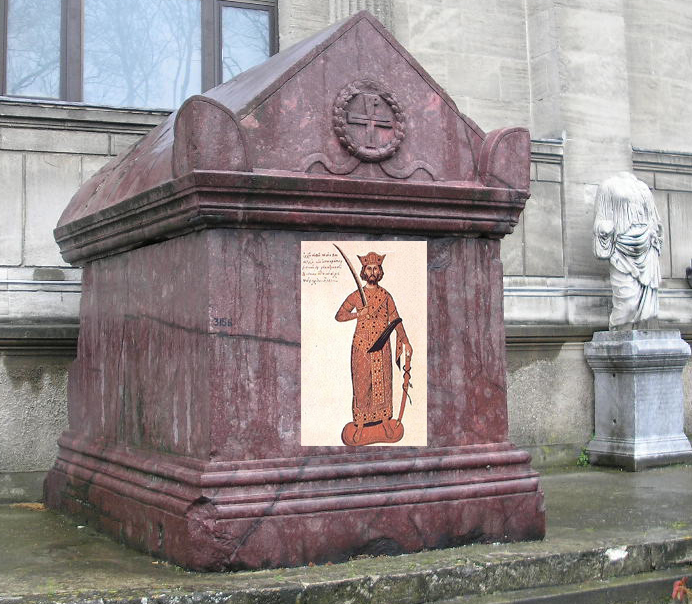
Istanbul Archeological Museum (entrance fee):  This is well worth a trip inside (a sarcophagus of Alexander the Great and the lions from the Bucoleon Palace among other things), but the gardens outside are also a treasure trove.  Most of the sarcophagi of the Patriarchs and Emperors were evicted from the Hagia Sophia and the Church of the Holy Apostles and those that survived ended up here.  Look for the porphyry (purple) ones.

Now for the deeper cuts.

The Church of the Pammakaristos (entrance fee): (Fethiye Camii) The haunting church of the Pammakaristos was refurbished in the 13th century in celebration of the retaking of Constantinople from the Crusaders. Commissioned by the emperor Michael VIII, Pammakaristos contains the largest collection of mosaics outside of Chora and the Hagia Sophia. After the fall of the city, the Patriarch moved the seat of the Patriarchate here, but was evicted five years later when the Sultan had the church converted to a mosque. Many of the original decorations were removed or damaged at the time, but enough remains to give a glimpse of the vanished grandeur of the Byzantine world.

The Myrelaion (free): (Bodrum Camii) If you’re a fan of the Macedonian Dynasty be sure to visit Romanus Lecapenus’ “House of Myrrh”.  Intended as an imperial mausoleum for the Lecapeni and as the core of a new Great Palace it was largely abandoned when his family fell from power.  Nevertheless it inspired a new building style- the Greek cross-in-square style that most Orthodox churches are still built according to.

Aqueduct of Valens (free): This was the original water source of many of the public fountains and baths in the city, transporting water from the Belgrade forest over 120 km away.  According to legend it was built from the stones of the walls of a nearby city that had been pulled down as a punishment for revolt. Repeatedly damaged over the centuries by earthquakes, it was repaired by nearly every famous (or infamous) emperor including Justinian, Constantine V, Basil II, and Andronicus the Terrible.

Sea Walls (free): Though large swaths were destroyed by a railroad in the 19th century, the remaining portions have been turned into a pleasant park.  If you exit the city near Sts. Sergius and Baccus you can see masonry from Justinian’s Column in a small gate.  A little further is the so-called ‘House of Justinian’- a two story facade of the Bucoleon Palace.  Next to that are the remains of the city’s pharos- its lighthouse.  The vaults beneath it functioned as the main treasury of the emperors.  Follow the walls long enough and you will come the the burial church of Alexius Comnenus (see picture at top of post) built right into the walls.  No sarcophagus has ever been found- perhaps he is still there in some hidden vault.

St. Polyeuktos (free): Though now only a rather ill-maintained sprawl of ruins near a highway, St. Polyeuktos was once the largest- and most lavishly decorated- church in Constantinople. Surpassed only by the Hagia Sophia, it was modeled on Solomon’s temple, and filled with inscriptions glorifying its patron’s impressive dynastic credentials. Since she happened to be a private citizen this was seen as a direct insult to the rather low-born Justinian, and may have encouraged the emperor to build his own church on such a massive scale. Upon entering the Hagia Sophia for the first time, Justinian is said to have exclaimed “Solomon, I have surpassed you”- perhaps a veiled reference to his rivalry with St. Polyeuktos. Unfortunately the sumptuous church fell into disrepair and during the Fourth Crusade much of its decoration was plundered. Some columns ended up as far away as Spain and Vienna, but undoubtedly the most famous sculptures taken from St. Polyeuktos are the four porphyry statues of the tetrarchs now included in the masonry of St. Marks in Venice.

Monastery of the Pantocrator (small fee to gatekeeper): This monumental building- the largest built after the age of Justinian- is actually three churches combined into one. The original building was constructed by the emperor John Comnenus in the 12th century and adorned by the ‘stone of unction’- the slab of marble that the crucified Christ had been anointed on before burial. When his wife died, the emperor built an identical church nearby, then added a chapel to connect them. A library and a hospital were attached to the foundation, and it became the mortuary chapel of the Comneni dynasty.  After the fourth Crusade it was used as a palace by the last Latin Emperor Baldwin II.  Partly ruined today, it can be entered with a small tip to the doorkeeper who usually hovers nearby. This is one of the overlooked masterpieces of the Byzantine world. On the walls are traces of the original decoration- which must have been truly splendid- and on the floor is the marble tombstone of emperor John II Comnenus.

St. John of Stoudios (usually inaccessible): The Studium was the most important monastery of Constantinople, and could claim no less than three emperors among its ranks. Although the monastery has been abandoned for more than half a millennium, several hymns composed there are still in use today in the Orthodox church, and its monastic rule is still used by the monks of Mt. Athos in Greece.

Blachernae Palace (free): Like the older Great Palace, Blachernae was a complex of buildings. Originally the site of a holy spring- and several churches built by Justinian- the last imperial dynasty chose it as the site for their official residence after the fourth Crusade. Unfortunately most of the buildings didn’t survive the fall of the city, but there are still the remains of some dungeons and a few subterranean vaults to be seen.  Don’t miss the nearby Palace of the Porphyrogenitus- the finest surviving example of secular Byzantine architecture.  Part of the grounds are now used to park tour buses, but the building still boasts fine marble decorations, and a faint wisp of grandeur.

There are many, many more Byzantine things to see- and the only fee most require is a spirit of adventure.  But this post is long enough and has been said elsewhere, the joy of Byzantium is in the discovery.

8 responses so far

Why did Justinian close the Platonic Academy?

Jul 12 2011

The closing down of the schools in Athens is often held up as the symbolic moment when  the traditions of the classical world finally ended.  It’s usually portrayed as the triumph of Christian intolerance over the cool-headed spirit of antiquity,  a rising tide of anti-intellectualism that snuffed out the last vestiges of the Greco-Roman tradition.  The leading actor in the saga- Justinian- is revealed to be a zealot and a boor, all too typical of the unfolding medieval age.

Unfortunately for Gibbon (and others who hold this view), it doesn’t stand up to any kind of scrutiny.  The idea of the Church being anti-intellectual is silly enough (if you enjoy reading Aristotle, Homer, or the other pagan authors of antiquity you can thank your local Byzantine monk)  As for Justinian, by the standards of the day he wasn’t particularly fanatical- quite the opposite.  He married a heretic (Theodora was Monophysite), and employed pagans- the most famous being John the Cappadocian.  There were the standard edicts ‘forbidding’ paganism but the emperor was blatantly violating that himself and there is no evidence that they were strictly enforced elsewhere.  Athens’ most famous landmark- the Parthenon- was probably still a pagan temple for the duration of Justinian’s reign.

So if he didn’t have an axe to grind against paganism why did Justinian close the Academy in 529?

Competition.  He had just founded a new University in Constantinople  which was directly under imperial control, and this was a convenient way to get rid of a rival.  He did the same thing to the main competitor of his new law school.  When an earthquake hit the renowned university of Beirut in 551 he took the opportunity to close it down (officially it was ‘moved’ but it never recovered) while transferring its most distinguished faculty to the capital.

Ruthless? Yes.  Anti-intellectual religious fanaticism? Not quite.

7 responses so far

Was Leo III’s reign good or bad for Byzantium?

Jun 25 2011

Jack asks if Leo III was beneficial or detrimental to the Byzantine Empire.

If you ask five historians this question you may very well get five different answers- Leo is a complicated figure.  I’ve changed my mind about him several times, but have gradually come to feel that he was a beneficial ruler.  Here’s why.

Leo was born in Syria (but grew up on the Black Sea Coast of Bulgaria) and cut his teeth on the eastern frontier.  This gave him a knowledge of the Arab mind that stood him in good stead when he became emperor.  When he arrived in Constantinople in 717 Byzantium was in a terrible predicament.  Heraclius’ dynasty had petered out with the bloody Justinian II, the Arabs were already on their way with a massive fleet and land army to exterminate the empire, and the current occupant of the throne (Theodosius III) was an overwhelmed tax collector who had been crowned against his will.  (When Leo arrived, Theodosius was more than happy abdicate and become the bishop of Ephesus)  A month after Leo’s coronation a gigantic Muslim army was pounding at the gates.  Things looked bleak but Leo somehow kept up morale and outmaneuvered the Arabs at every turn.  Within months they were suffering from inadequate sanitation and freezing temperatures.  After they were appropriately demoralized Leo sent in the fireships against the enemy navy and- in what is surely one of the most brilliant unsung victories in history- managed to bamboozle the Bulgarians into attacking the Arab army for him.  Less than half of the Muslim infantry made it home and the grand fleet lost all but 5 ships.  Had there been a less capable man on the throne (Theodosius III for instance), Constantinople probably would have fallen in the eighth century and Islam would have had a free run at an undeveloped and divided Europe.

That’s the part of the legacy that most can agree is positive.  Offsetting that is Iconoclasm.  In 726 Leo came to the conclusion that the Byzantine love of icons had strayed into idolatry and he ordered the city’s most prominent icon to be torn down.  That unleashed two centuries or so of controversy that was among the most destructive in the empire’s history.

So why conclude that his reign was on balance beneficial?

Because I think it’s unfair to blame Leo for everything that came after him.  And by the true iconoclast’s standards, it’s doubtful that he was really even one of them.  The use of icons had gone overboard- they stood in for godparents at baptisms and most people agreed that it could stand to be ratcheted down a notch or two.  There was also a popular belief that Arab victories in Asia (and the terrible earthquake of 726) were due to divine displeasure over idolatry.  Leo gave a sermon in the Hagia Sophia to that effect and it was greeted with rousing applause.  I don’t think he ever intended to say that icons were inherently bad- he promulgated a revision to the law code in 726 that didn’t even mention them- and contemporary Muslim and Armenian sources don’t number him among the iconoclasts.

His most controversial action was to rip down the famous icon above the imperial palace, but this can be explained in two ways.  First, just before the Arab army had been routed the Patriarch had processed around the city walls bearing an icon of Mary and the subsequent victory was credited to divine intervention.  Leo’s own efforts were downplayed and it’s quite possible that he was a tad peeved.  Secondly (and more importantly), he replaced the icon with a simple cross and the inscription “I drive out the enemies and kill the barbarians.”  I think this was an attempt to resurrect the cross as a victorious symbol.  Leo’s main argument was always that the Arabs were winning because the Byzantines had abandoned their true faith.  What better way to get back to basics than by fighting under the same symbol that had led Constantine and Heraclius to such incredible victories?  This was not so much a strike against the idea of icons as it was a re-branding.  There is no evidence to suggest he ever persecuted those who disagreed with him on the issue, and in fact he (ironically) tried to promote religious unity his entire reign.  He was always a moderate and for most of his reign he had popular opinion on his side- hardly the divisive figure later writers tried to make him.  His son Constantine V, on the other hand, took the whole thing to an extreme.  He really did have a theological axe to grind against icons and suppressed them with a single-minded fervor that crossed into obsession.

It’s been all too easy for most historians to throw Leo under the bus as the guy who started all the trouble.  Somehow it seems a bit ungrateful to blame him for his successors’ fanaticism…

One response so far

Older »